This article covers the basic principles and key specs of armored thermal resistors, plus a selection guide to help you pick the right armored thermal resistor.
Overview
The armored thermal resistance is a type of temperature sensor. Compared with the assembled platinum resistance, it has a smaller diameter, is flexible, and offers excellent vibration resistance, making it suitable for installation in locations where assembled thermal resistances cannot be installed.
The WZPK series armored thermal resistances produced by our company adopt a lead thermal resistance temperature-sensing element. Therefore, they feature high precision, sensitivity, short thermal response time, stable quality, and a long service life.
The outer protective sleeve of the armored thermal resistor is made of stainless steel, and it is filled with a high-density oxide material insulator. Therefore, it has strong anti-pollution performance and excellent mechanical strength, making it suitable for installation in harsh environments.
The armored thermal resistor can be used to measure temperatures in the range of -200 ~ 500°C, and can be directly connected to secondary instruments using copper wires. Thanks to its good electrical output characteristics, it can provide accurate temperature change input signals for displays, recorders, regulators, scanners, data loggers, and computers.
Working Principle
The working principle of the armored thermal resistor: Under the action of temperature, the resistance of the thermal resistance wire changes accordingly. The display instrument will indicate the temperature value corresponding to the resistance value generated by the thermal resistor.
Structure of Armored Thermal Resistor
The structure of the armored thermal resistor is the same as that of a conventional thermal resistor, except that three of the five components (the temperature-sensing element, insulating material, and protective sleeve) form an integral armored body.
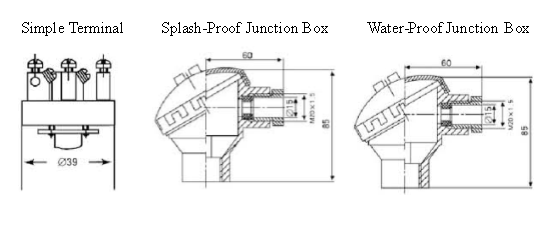
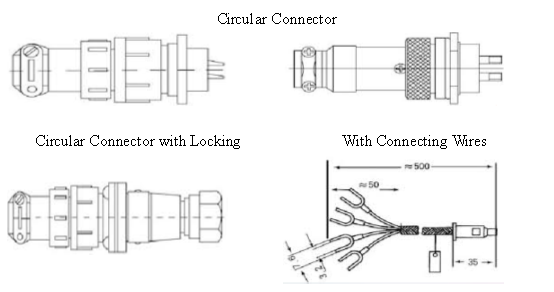
Armored body (temperature-sensing element, insulating material, protective sleeve): For the thermal resistor, the temperature-sensing element refers to the sensing component and its internal leads. Magnesium oxide is used as the insulating material between the leads of each thermal resistor, as well as between the leads and the protective sleeve; a metal tube protects the insulating material and the temperature-sensing element. The armoring process combines the temperature-sensing element, insulating material, and protective sleeve into an inseparable, flexible compact entity. The armored body is the base material for manufacturing the armored thermal resistor. It cannot be directly used for temperature measurement; it can only be used as a basic armored thermal resistor after being equipped with a measuring terminal and a simple wiring terminal.
Main Technical Specifications
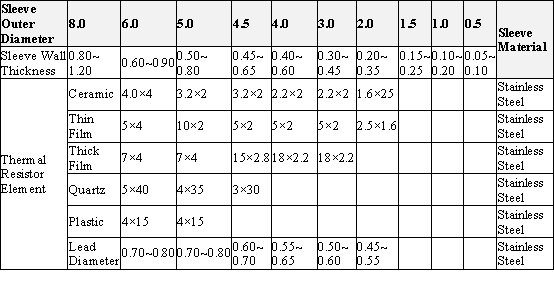
★ Diameter and Related Parameters
★ Recommended Preferred Lengths

For the resistance temperature detector (RTD) sensing element, W₁₀₀ = R₁₀₀/R₀ refers to the ratio of its resistance value at 100°C (R₁₀₀) to its resistance value at 0°C (R₀).
For the Pt100 temperature coefficient:
Class A: R₀ = 100 ± 0.06 Ω
Class B: R₀ = 100 ± 0.12 Ω
W₁₀₀ = R₁₀₀/R₀ = 1.3850
★ Temperature Measurement Range and Allowable Error
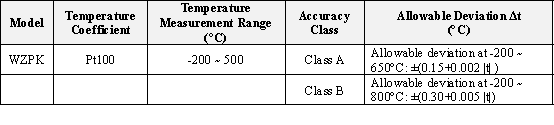
★ Note: In the formula, "t" refers to the absolute value of the actual measured temperature of the sensing element.
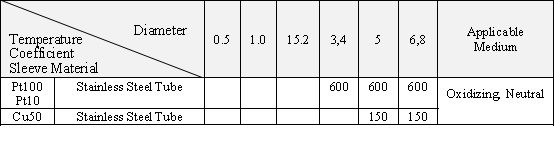
★ Recommended Maximum Operating Temperature and Applicable Medium
★ Nominal Pressure
It generally refers to the static external pressure that the protective tube can withstand without cracking at room temperature. The test pressure is typically 1.5 times the nominal pressure. In practice, the allowable nominal pressure is related not only to the material, diameter and wall thickness of the protective tube, but also to its structural form, installation method, insertion depth, as well as the flow rate and type of the measured medium.
★ Thermal Response Time
When the temperature changes stepwise, the time required for the output of the RTD to change to 50% of the step change is called the thermal response time, denoted as τ 0.5
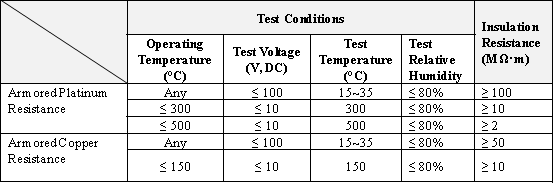
★ Insulation Resistance of RTD
For the room-temperature insulation resistance test, a DC voltage of 10~100V (any value in this range) can be used. The test should be conducted under conditions of ambient temperature 15~35°C and relative humidity not exceeding 80%; the room-temperature insulation resistance value should be no less than 100MΩ
★ Wiring Mode